Life Now
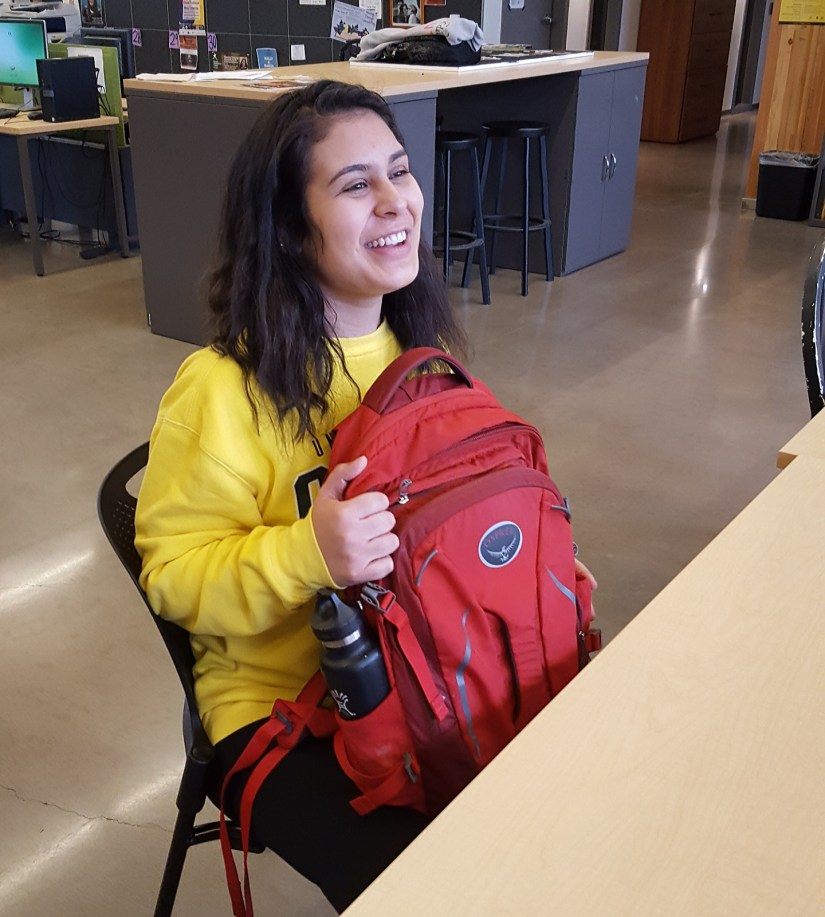
The alarm goes off at 7 a.m., reminding Paola Lopez that she has a long day ahead. After getting ready she packs a lunch with snacks for the day, and heads to the EmX bus station. It’s now 9:15 a.m., as she boards the bus for the campus. The 15-minute bus ride allows her time to relax while listening to her favorite tunes. Sporting black leggings, a yellow UO sweatshirt, and a red Osprey backpack – she walks into the Multicultural Center at the Erb memorial union to check her email before her 10 a.m. accounting class. When she’s not in class she is studying and doing homework on-campus until 3:30 p.m. and working one of her two jobs from 4 p.m. to 10 p.m. This is her schedule from Monday through Friday. Each day and hour is planned out because you don’t have time to waste when you’re in a race against time. A junior at the University of Oregon, Lopez is working two jobs and has been paying for her education herself. This past fall she received a small scholarship from the Mexican Consulate in Portland, and she will have to re-apply for it every year. Lopez wants to become an accountant and dreams of buying a home for her parents. Taking 16 credits a term and working 30 hours a week is enough to stress anyone out. Add the uncertainty of not knowing the fate of your legal status in the United States until sometime this spring, and you’ll understand the pressure of a typical day for Paola.
Paola Lopez is a Dreamer. Fighting for her version of the American Dream. When Lopez thinks about the negative comments she hears regarding immigration and DACA, she gets emotional. She said her mother did not want to come to the United States, but she didn’t have a choice. Her mother graduated from the University of Guadalajara with a degree in Communications, but could not find work. They did not have any support from the family and needed to leave. “Immigration is a sacrifice for a better life that you can’t find anywhere else,” said Lopez. “My mom didn’t want to clean toilets or work at a fast-food restaurant but you sacrifice everything for a better life.”
Lopez aspires to graduate from the UO before DACA is rescinded. “DACA has given me a little light of hope,” she said. I can work legally, something my parents still can’t do.” Lopez said she understands how much her parents have sacrificed for her and her brother. “I see my mom break her back to only make minimum wage,” she said. “I notice my dad’s blistered hands.” People tell me our family should have done it legally, she states. They say we need to go back to our country and come here the right way, she cries “But there’s no straight path to citizenship, it’s not as easy as people think it is,” she said. “Despite everything, I’m lucky to be here.”
She said DACA has given her the freedom to no longer be scared at a traffic stop. She no longer worries about getting rejected at a bank because she does not have a social security card. “I’m proud of how far I’ve come,” she said. “Despite all the obstacles, I look forward to seeing all the things I have ahead of me.”
That’s the reality for millions of immigrants and Dreamers in the United States. DACA is in limbo because Congress has not made a decision regarding the future of the program. There are currently 687,000 Dreamers with active DACA status in the U.S. with an uncertain future.
Surviving the journey – a new world
Lopez was 6-years old when she crossed the border from Tijuana, Mexico, to San Diego, California. With fake passports, Lopez said she walked across the border holding hands with her mother and her younger brother. “At the hotel in Tijuana we had to memorize information from our passports,” said Lopez. “We got through really easily.”
Lopez said they left their hometown Jalisco, Guadalajara by plane in the morning and flew into Tijuana. Within an hour, they had their passports. They memorized birthdates, home addresses and were instructed to say they were going to Disneyland. “I remember the first restaurant we stopped at before we crossed was Carl’s Jr,” she said. “That’s where we met our coyote.” A “coyote,” is a Mexican-Spanish term referred to a person who smuggles migrants across the U.S.-Mexico border. By the evening, they were reunited with her father.
Her father was already living and working in San Jose, California – but not legally. Because of that, her mother was not able to get visas for her and her brother in order to travel. She didn’t know much about her father, but she had small memories of him from Mexico. Lopez said she believes her father’s pictures and the need to reunite with her father kept him alive in her mind – her heart. “I didn’t have a dad in Mexico, so when we met him my brother Carlos was scared of him,” she said. “I was excited.”
Lopez said they lived in San Jose until they could no longer afford it. They moved to Springfield, Oregon, when she was in the 6th grade.
At 16-years-old, she applied for the Deferred Action for Childhood Arrivals program and recently renewed it before the 2018 deadline. She then graduated from Springfield High School in June of 2017 and will be a senior at the University of Oregon this fall. “You work so hard and one piece of paper decides what you can and can’t do,” she said. “It disappoints you.” Her DACA will expire this year.
This past June, she saw her grandmother for the first time in 12 years. Her grandmother is 85-years-old with medical issues and was able to spend two weeks in Eugene. Lopez said she believes it was the last time they will see her alive.
DACA
On June 15, 2012, President Barack Obama, and the U.S. Department of Homeland Security (DHS) announced the United States would not deport qualifying undocumented youth who came to the United States as children. According to the U.S. Citizenship and Immigration Services (USCIS) agency, The Obama administration called this program Deferred Action for Childhood Arrivals or DACA. Under DACA, undocumented immigrants without felonies or misdemeanors are eligible for a work permit and safe from deportation within a two-year period. Unlike the DREAM ACT, DACA recipients do not have a clear path to citizenship or permanent lawful status.

The Migration Policy Institute (MPI) research shows that only 18% of DACA recipients are currently enrolled in college. Out of that 18%, only 4% will graduate. However 44% of DACA recipients have earned a secondary education, and 97% percent of DACA recipients are currently employed or enrolled in school.
Lopez understands all of this. She knows that DACA has granted her privileges that many undocumented immigrants do not have. They are privileges that her mother does not have, such as having a work permit, the opportunity to apply and earn a driver’s license, and the freedom from not getting deported. Despite the political climate, negative sentiment towards immigrants delivered from the white house or rude customers at her work, she endures.
The article written by Michelle Ye Hee Lee for The Washington Post titled, Donald Trump’s false comments connecting Mexican immigrants and crime brings light to the negative attitude towards people like, Lopez. Lee mentions that according to our President, “When Mexico sends its people, they’re not sending their best. They’re sending people that have lots of problems, and they’re bringing those problems with us. They’re bringing drugs. They’re bringing crime. They’re rapists. And some, I assume, are good people.”
But, there’s no evidence showing immigrants commit more crimes than native-born Americans. In his article written for The Washington Post titled, Two charts demolish the notion that immigrants here illegally commit more crime Christopher Ingraham mentions that, according to a study published by the libertarian Cato Institute in 2015 which examined criminal conviction data by the Texas Department of Public Safety, “native-born residents were much more likely to be convicted of a crime than immigrants in the country legally or illegally.” A study published in March of this year in the journal Criminology found that, “from 1990 through 2014, states with larger shares of undocumented immigrants tended to have lower crime rates than states with smaller percentages,” said Ingraham.
The U.S. Supreme court will decide on the fate of DACA later this spring.
Moving forward
Lopez knows that not everyone cares to understand her struggles and her family’s journey. She doesn’t hold a grudge toward anyone who thinks she should go back to Mexico. Instead, she’s open to having a conversation, and educating anyone who’s willing to listen.
With the uncertainty of DACA, Lopez is in a race against time. She’s busy going to class and studying to be an Accountant while working two jobs in order to pay for it all. Her short term goals are to graduate from the University of Oregon before her DACA expires. Her long term goals include finding and keeping a job. She wants to get married, and have a family. She would also like to buy her parents a home. Lopez wishes they could travel to Mexico to see her grandmother and the rest of her family.
Lopez understands the significance of her parents sacrifice. Risking it all to provide her and her brother with a better future. Understanding their struggle, and fulfilling their dreams for a better future makes her own battles easier to handle. “What keeps me going is knowing that I’m making my parents proud,” said Lopez. “I’m not wasting the sacrifice.”
Dealing with anti-immigrant rhetoric, and sleepless nights from studying and working two jobs – tolerable. “My parents left everything behind in order for me to be here – in order for me to do it,” said Lopez. “One day, I will be where my parents wanted me to be.”





 Luis Renteria